

Perfume Market Size to Worth USD 87.17 billion by 2034 | CAGR of 5.73% during 2026-2034
Perfume Market
Perfume Market Size, Fragrance Trends, and Growth Forecast 2026–2034
North America dominated the perfume market with a market share of 35.57% in 2025”
PUNE, MAHARASHTRA, INDIA, February 8, 2026 /EINPresswire.com/ -- Perfume Market Overview Analysis, 2026— Fortune Business Insights
The global perfume market is experiencing robust expansion driven by increasing consumer demand for personal grooming products and evolving fragrance preferences. Recent analysis reveals promising growth trajectories across multiple market segments and geographic regions.
Market Size and Growth Projections
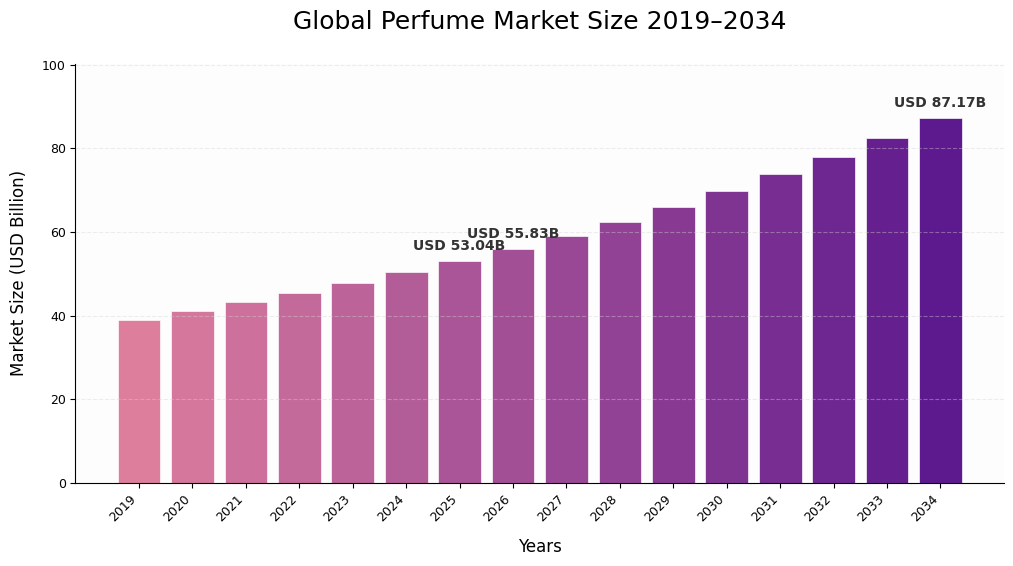
The worldwide perfume market achieved a valuation of $53.04 billion in 2025, with projections indicating growth to $55.83 billion in 2026. By 2034, the market is forecast to reach $87.17 billion, representing a compound annual growth rate of 5.73% throughout the forecast period. This steady expansion reflects both rising disposable incomes globally and heightened consumer awareness regarding personal care products.
Request a Sample PDF: https://www.fortunebusinessinsights.com/enquiry/request-sample-pdf/perfume-market-102273
Market Size & Forecast
2025 Market Size: USD 53.04 billion
2026 Market Size: USD 55.83 billion
2034 Forecast Market Size: USD 87.17 billion
CAGR: 5.73% from 2026–2034
Regional Market Dynamics
North America maintains market leadership with a commanding 35.57% share in 2025, propelled primarily by strong consumer spending on premium fragrance formulations. The United States market specifically is anticipated to reach $23.23 billion by 2032, supported by growing adoption of innovative scent technologies and robust e-commerce infrastructure.
The Asia Pacific region demonstrates the fastest growth potential, driven by expanding middle-class populations in China and India, coupled with increasing grooming consciousness. Chinese consumers show particular preference for luxury and sustainable fragrance offerings, while India's market benefits from rising working-class populations and enhanced retail accessibility. The Middle East experiences growth through booming e-commerce platforms, with Saudi Arabian online fragrance sales notably doubling between 2017 and 2020.
Market Trends
The consumers prefer waterless hygiene items that reduce unpleasant odors immediately. Besides, they prefer fragrances made up of sustainable materials such as vanilla beans, balsams, citrus oil, and others to avoid headache and eye & ear disorders due to the usage of chemical-based ones. This will offer newer growth opportunities to key players. Additionally, launch of aromatherapy-based scents by key players is likely to ease their product sales. For instance, in August 2020, Vectair Systems launched ‘Sensamist,’ a range of aromatherapy-based scent diffusers in the America market.
Product Segmentation and Consumer Preferences
Traditional perfume maintains dominance within the type category, commanding 33.98% market share in 2026 due to superior fragrance concentration and extended longevity of six to eight hours. However, eau de perfume emerges as the fastest-growing segment, appealing to consumers seeking cost-effective yet durable alternatives.
Within product categories, mass-market fragrances lead with 54.56% share in 2026, attributed to bulk manufacturing and affordability. Nevertheless, premium segments show accelerated growth as manufacturers focus on natural ingredients responding to consumer concerns about synthetic fragrance allergies.
Women represent the larger end-user segment at 53.52% share in 2026, reflecting sustained interest in sustainable fragrances for personal grooming. Notably, the men's segment exhibits significant expansion as grooming awareness increases among male consumers seeking stronger, more aromatic formulations.
Innovation and Technology Integration
Industry leaders increasingly invest in technological advancement to enhance consumer experiences. Recent innovations include artificial intelligence-powered scent profiling systems that provide personalized fragrance recommendations based on individual preferences. Companies like Sephora have introduced touchless scent bars incorporating AI applications, particularly successful in Asian markets like Hong Kong.
Aromatherapy-based formulations gain traction as consumers seek wellness-oriented products. Manufacturers respond by developing waterless hygiene items using sustainable materials such as vanilla beans, balsams, and citrus oils, addressing consumer preferences for environmentally responsible options while avoiding synthetic chemical concerns.
Distribution Channel Evolution
Online retail channels demonstrate remarkable growth, benefiting from expanding internet accessibility and digital payment adoption. Global internet usage reached 69% of the population in 2022, equating to 4.9 billion active users. E-commerce platforms offer attractive promotional discounts that significantly influence purchasing decisions, with worldwide online retail sales growing from 16% of total retail in 2019 to 19% in 2020.
Despite digital channel expansion, offline retail maintains 61.45% market share in 2026, supported by increasing retail outlet numbers in developing nations and rising consumer disposable income. Traditional retail experiences continued growth in markets like India, where retail sales increased 9% year-over-year in September 2023.
Market Share
North America dominated the perfume market with a 35.57% share in 2025, driven by high demand for premium formulation-based perfumes and increasing consumer spending on personal grooming in the U.S., Canada, and Mexico.
By type, perfume is expected to retain the largest market share in 2025, due to its superior fragrance concentration and long-lasting application (up to 6–8 hours), making it highly preferred by consumers. The eau de perfume segment is expected to be the fastest growing due to its cost-effectiveness and durability.
Click for an Enquiry: https://www.fortunebusinessinsights.com/enquiry/book-a-call/perfume-market-102273
Market Challenges and Opportunities
The industry faces constraints from substantial research and development investment requirements necessary for innovative product development. Additional challenges include unpredictable consumer behavior patterns and health concerns related to synthetic fragrances causing skin irritation and headaches among certain users.
However, opportunities abound through expanding e-commerce infrastructure, growing awareness of personal grooming across demographics, and increasing preference for natural and sustainable fragrance formulations. Major industry participants including L'Oréal, Unilever, Coty, Procter & Gamble, and Estée Lauder continue expanding geographic presence through strategic partnerships, product launches, and retail network expansion, particularly in emerging markets.
The perfume market demonstrates resilience and adaptability, successfully navigating consumer preference shifts while embracing technological innovation to deliver enhanced personalized experiences across diverse global markets.
Read More Research Reports:
Luxury Goods Market Size, Share & COVID-19 Impact Analysis
Deodorant Market Size, Share & Industry Analysis
Ashwin Arora
Fortune Business Insights™ Pvt. Ltd.
+1 833-909-2966
sales@fortunebusinessinsights.com
Legal Disclaimer:
EIN Presswire provides this news content "as is" without warranty of any kind. We do not accept any responsibility or liability for the accuracy, content, images, videos, licenses, completeness, legality, or reliability of the information contained in this article. If you have any complaints or copyright issues related to this article, kindly contact the author above.
